Friday, May 6, 2011

First Tour of the New Season

by Lynnda + pics by aleks (a.k.a. 'the other guide')

Thursday was my first official tour of the 2011 season. This was my first tour of my second year of guiding. I've been rereading my training manual for the last month. We were given so much wonderful information that it is hard to decide how to limit a tour to one hour.

(click on pics to enlarge)
SJG • 5/5/11 - Cherry blossom at the orchard

And here comes the group - 14 women from West Seattle, and no other guide! Wait - here comes the other guide! Now I can more easily walk over the shedding stone. My group started at the glass windows in the T Room, incredible art that won't be seen unless we detour to the back of the building.

SJG • 5/5/11 • Through cherry blossoms: Gardeners  candling the pines on Turtle Island

The weather contributed much to the tour. It was chilly with leaden gray skies, but the azaleas in bloom seemed more vibrant. Raindrops on the various maple leaves that had begun to leaf out gave the colors more intensity. I especially like looking up into the Japanese Maple, Acer Palmatum Shigitatsu Sawa, at the SW corner of the Tea House. The reticulated veins were magnified by the rain drops hanging on the leaves' edges. There was a calmness that pervaded the Garden. Not one single turtle showed its head. Gardeners were on ladders in the pond, candling the pines on Turtle Island. Maybe they scared the turtles away.

SJG • 5/5/11 • Close up cherry blossom
My group seemed to enjoy their tour, and I encouraged them to come back again to take a tour with other guides. Each of us has our own information and way to present it, and there would be different plants in bloom, different weather, and a completely different visual effect on a sunny day.

P.S. From aleks: can somebody please tell me the full name of the cherry blossoms currently in bloom?  Those are the full, double or triple ones, darker pink than pale pink yoshino....
P.P.S. 5/10/11 - Oh, these are kwanzan cherries...

Thursday, May 5, 2011

Seen in the Garden Today: Primula japonica

by rpacht & aleks
Primula japonica • Japanese primrose • sakura-so

rpacht took some pics on his public tour yesterday:)....  He has problems with posting them himself, so it's a communal post....

SJG 5/4/11 • Primula japonica patch • Photo by rpacht

SJG 5/4/11 • This guy posed for us much to the delight of the children
on my public tour yesterday.  Photo & caption by rpacht


SJG • 5/5/11 • Primula close-up by aleks
Description
Japanese Primrose is a charming herbaceous perennial with its bright flowers in shades of pink and held atop wrinkled, wavy cabbage green leaves. This makes an ideal plant for the wet shaded spots in a garden. 
Morphology: 
This is an herbaceous perennial which grows to 18”-24”. Leaves are oblong-ovate and have toothed margins. The plants grow in a rosette mound. 
More at the WSU page...


Tuesday, April 26, 2011

Seen in the Garden Today: Trillium

Trillium in Japanese: enrei-so
by Lynnda

On Tuesday, I visited the Garden with a friend who is a botanist. At times, the sun was shining, but moments later, dark clouds changed the mood and temperature. The turtles couldn't decide whether to climb onto rocks and wait for the sun or to go for a swim. The sword ferns have begun to unfurl their new fronds. Although this spring has been slow in arriving, the Garden is beginning to show signs of renewal.

On the west side of the WPA bridge, there are a few
 clumps of trillium, such lovely early harbingers of spring. What I learned from my friend is that trilliums change color once they have been pollinated. It's a trick that the flowers do to help the insects know that they should go find another flower to pollinate. The more time that passes since the pollination, the darker in color the trillium becomes until the flower turns to burgundy. Most of the Garden trilliums are still a very snowy white.


As we were walking on the west side of the pond, we heard the "cheep, cheep" of an osprey, and looking up, we saw it being chased by a crow. It was a lovely day in the Garden, and there were so many more plants beginning to bloom. This is the time of year that a visit each week gives an opportunity to greet another friend returning from a long winter absence.

Monday, April 25, 2011

The Sun Always Rises •  A Benefit Concert for Japan

Cherry blossoms
UW campus  April 2011
Saturday May 21, 2011 at 7:00 pm
at ACT's Falls Theatre


700 Union Street Seattle, WA, 98101
All proceeds will go to the Japanese Red Cross Society.

For one night, Seattle musicians come together for an evening of music to benefit the Japanese Red Cross Society and its ongoing relief efforts in areas hardest hit by the Great East Japan Earthquake. The concert is made possible in part by the generosity of ACT (A Contemporary Theatre) who has donated the use of the Falls Theatre for the event.

The lineup of artists includes Sarah Rudinoff, Miss Mamie Lavona the Exotic Mullatta and Her White Boy Band, The Live Girls! Ladies Choir, Jacqueline Tabor, Total Experience Gospel Choir, as well as three taiko drumming groups – One World Taiko, Kaze Daiko, and Seattle Kokon Taiko. Local favorite actress and performer Kate Jaeger (Teatro Zinzanni’s Zirkus Fantasmo) will serve as Mistress of Ceremonies. The evening’s proceeds will go to Japanese Red Cross Society.

In addition to the performers who are donating their time, several theatre companies in Seattle are joining the effort by providing services, taking up collections or donating a portion of their box office from one evening’s performance of their current show with the help of TPS (Theatre Puget Sound).  Participating theatres are: Wing-It Productions, Pork Filled Players, SIS Productions, Youth Theatre Northwest, and Live Girls! Theater Company.

Tickets: All tickets for The Sun Always Rises are $25. To purchase tickets, contact ACT box office at (206) 292-7676 or go to www.acttheatre.org

Thursday, April 21, 2011

Seen in the Garden Today: Mt. Fuji cherry blossoms and a bunch of New Yorkers

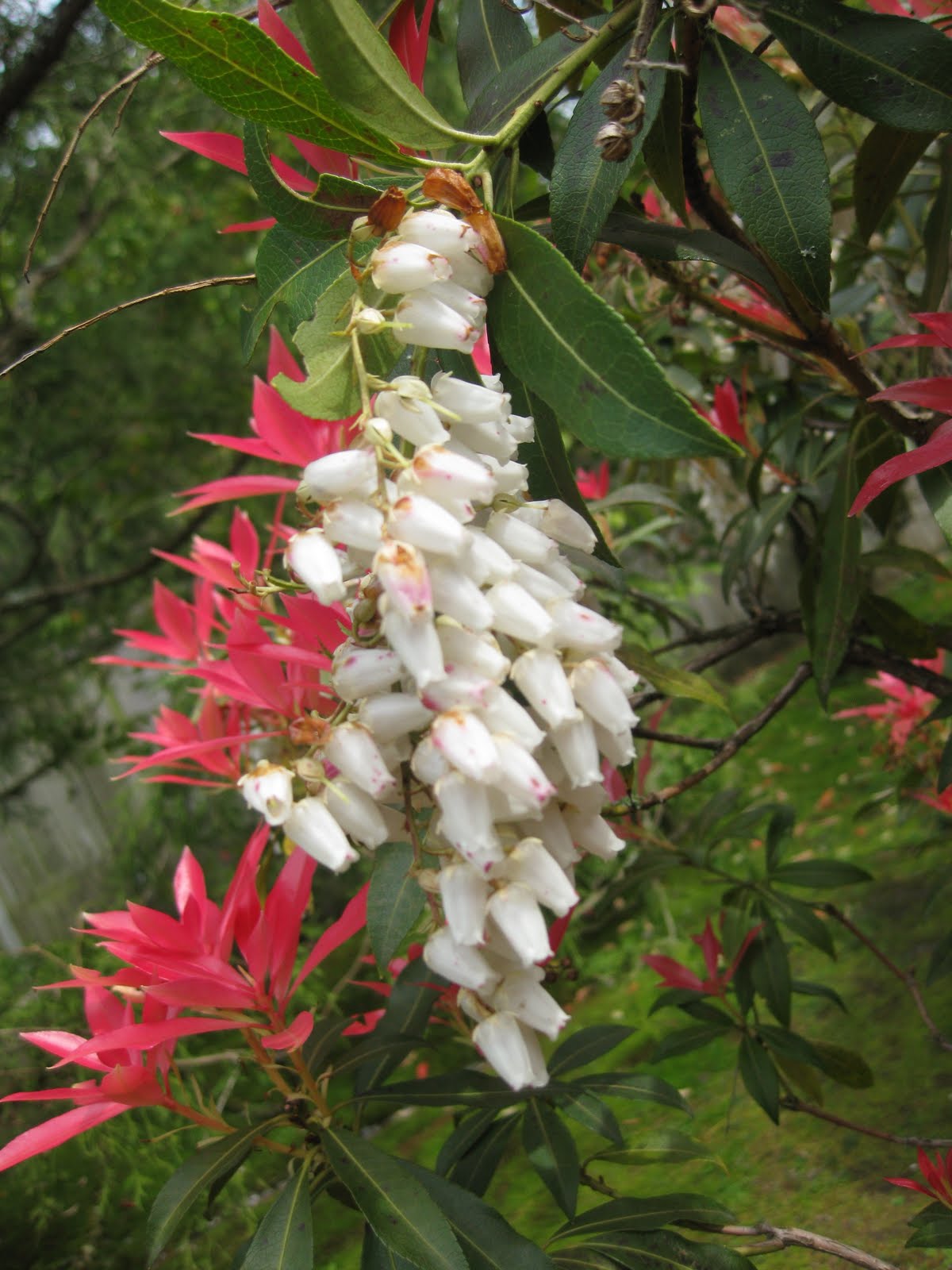
SJG • Pieris or Enkianthus? (for answer read
the bottom of the post) pic added 4/24


Pieris in Japanese: asebi
Flowering cherry in Japanese: sakura

by aleks
(Click on the pics to enlarge them)
•  Pieris or Enkianthus?  When Dewey and I were waiting for our tour-people to arrive from wherever they got stuck last Tuesday, a lady just leaving a garden approached us asking for a name of a particular bush that she saw in bloom on the path to the wisteria trellis; she described it as having pendulous bell-like white flowers and said she looked it up in our plant book but still couldn't locate its name.  I'm pretty hopeless with plants so could only offer to take a pic of the shrub, try to find out what it is and post the answer on the blog, but the lady's next statement, that she originally thought the plant has flowers in two different colors, until she looked closer and noticed that the red stuff is not a flower but a new growth, made Dewey cough up the answer: 'very likely Pieris Japonica, which is in bloom now'.  I was so happy that the question was answered that I didn't photograph the plant, although did stop to admire it. Just now looked in the plant book and found no pieris in the area...:( but found Enkianthus campalunatus which,  if i remember correctly, closely resembles pieris at certain times of the year.  So, the jury is still out - I'll go back and photograph the bush before identifying it here, although I suspect it IS enkiantus as the flowers seemed more open, lily-of the valley-like and not closed at the bottom as pieris has...

 • Mt. Fuji cherry tree...

SJG 4/18/11 - Mt. Fuji cherry
The tree was ceremoniously planted only last fall and it already has glorious blossoms this spring!  The ceremonious part was on the account of the tree being 'a propagation of the one planted by Japanese Crown Prince Akihito in 1960', as the plaque underneath reads;  the ceremony involved the Japanese ambassador and a shinto priest, I believe. I hope somebody takes the time and answers my burning question as to how one propagates a tree that has been dead for several years, at least - it's been dead since I became a docent some 7 or 8 years ago.
SJG 4/18/11 • Mt. Fuji cherry
blossoms up-close

During that time I really enjoyed tantalizing the first-graders by showing them the European birch tree planted at the same time by princess Michiko, while informing them that prince's tree fell due to the excess of snow a while ago;  the story usually produces an excited question from a young mind: 'SO, did you tell the prince?!'  Nope, not really, then prince is now an Emperor of Japan and who would like to write this message: DEAR EMPEROR, YOUR TREE IS DEAD!  The kids pause and sometimes nod - you can tell they are pondering the dilemma between spilling the beans and being polite... I hope the answer about propagating a has-been tree will provide me with a new way to torment the young minds!

Bunch of New Yorkers - SJG 4/18/11
• The New Yorkers.  They were a real cheery, outgoing crowd of teachers from The Bank Street College of Education in NYC:  funny, engaging and curious group to lead around the Garden.  And I forgot how extrovert the east coast city dwellers are, too: at some point I was snapping the pic of a blooming apple tree and a part  of the group made it into the frame. I turned around and jokingly asked:  are you ready to have your pic taken for the blog, for the whole world to see?  Not only they didn't shy from a camera, they lined up and proudly produced a shopping bag with the name of the school to front them! :)  HI, New Yorkers from The Bank Street School!  Hope you made it safely home and please, come and see us again!

P.S.  4/24/11 - Added (pieris?/enkianthus?) pic above and now consulted the newest edition of the Plant Book (previously looked into the 2008 version) - that area has 5 pieris japonica and 1 enkianthus:  now I tend to think this is pieris, but PAGING KATHY L.

P.P.S.  4/25/11 - Kathy L. wrote: 'It is Pieris as the Enkianthus are not in bloom yet'...  Well, that settles it, doesn't it?  Thank you, Kathy!

_____________
鳶が鷹を産む。 •  Tonbi(or Tobi) ga taka o umu. • Literally: A kite breeding a hawk. • Meaning: A splendid child born from common parents.

Saturday, April 16, 2011

Other Gardens: UW campus cherry blossoms - Sakura Saku

Flowering cherry in Japanese: sakura
by aleks
(Click on the pics to see larger versions)

UW Yoshino Cherry grove
Technically not a garden, but a grove of 30 mature Yoshino cherry trees over at the quad area of the UW campus; they are a tourist attraction in themselves when they bloom for about 2 weeks every spring.  They are a bit late this cold, wintry  year, as everything else seems to be - I found pictures of them on the web from last year dated march 27th (look at the date above: April 16th).

Whenever they bloom, they are a total show-stopper:   transplanted from the Seattle Arboretum 45 years ago when a freeway project threatened them, they now live happily here, at UW campus, and  'snow' delicate pink petals with a smallest stir of wind - an absolute magic to see. Today I came upon two young women meeting under a  blooming tree - one was approaching the other with an open box full of cupcakes when the wind blew and petals snowed on them:  the students happily laughed and one of them exclaimed: 'Oh, now the cherry blossoms everywhere!'...


'Snow' of the cherry petals • UW 4/16/11
• The story of cherry trees at UW:
[...] Students who walked through the Quad during spring can tick an item off their to-do list: seeing one of the world’s wonders. The Yoshino cherry tree (Prunus x yedoensis) should indeed be counted among such beauties as the pyramids and the Great Wall of China.


Yoshino is originally native to Japan’s natural landscape. It is a natural hybrid, first described in 1870 as a small deciduous tree growing up to 12 meters tall. It produces small cherries that are an important food source for many birds and mammals. The life expectancy of a Yoshino cherry tree is 60 to 100 years. [...]
From 'Campus trees a living history', UW's paper article - more here....

'What a strange thing! / to be alive / beneath Cherry blossoms!'
Kobayashi Issa (can't find Japanese original - Keiko, help!)

• Video: Cherry blossoms in full bloom on UW Seattle campus:
It’s a cruel joke. Cherry blossoms are at their peak over spring break when students have fled the campus for vacations and a little off-campus reprieve between winter and spring quarters.
Go to this UW link to see an amazing video of cherries in bloom in 2010 - more here...

Yoshino cherry blossoms • UW 4/17/11
* * *
And if you missed the cherry blossom show at UW come to Seattle Japanese Garden: it  is located in a lowest part of Arboretum, with temps about 10 degrees lower than the rest of the city, so cherry blossoms in the orchard part come there later yet, about a week or two after the city trees. You will be stirred by their beauty.

1810

.夕桜鬼の涙のかかるべし
yûzakura oni no namida kakarubeshi

evening cherry blossoms--
the devil is moved
to tears

Kobayashi Issa (1763 - 1827), translated by David G. Lanoue
_________________

• Links to Hanami stories/pics:
- Human Flower Project: Under the cherry blossoms - Masashi Yamaguchi offers an introduction to Japan’s lush cherry blossom customs.
- Sakura and the Japanese mind - article by Shigeru Awagi, born in 1926, in Miyazaki-ken, Japan.
– Japanese Culture–Cherry Blossom Season Hanami - article from SE Asia History
- Special Project:  How Seattle's Cherry Blossoms Made a Journey into Space - from Consulate-General  of Japan in Seattle
- History of the Cherry trees in US -  National Park Service page
- Visit Seattle Japanese Garden Flicr group: I'm sure there will be great hanami pics there as soon as bloom in SJG.

• Locations for great Hanami in Seattle: Lake Washington Boulevard, The Seattle Center, the Arboretum, the Japanese Garden, the University of Washington, Seward Park, Woodland Park, and the Seattle Buddhist Church Wysteria Plaza.  ADD YOURS!
________

十人十色 (jūnin toiro) Literally: ten men, ten colors 
Meaning: To each his/her own. / Different strokes for different folks.