Friday, December 24, 2010

メリークリスマス

The stats for SJGCB tell us we have readers around the world - thank you for stopping by and to all of you:

メリークリスマス
Merry Christmas
明けましておめでとうございます 
Happy New Year

Thanks, Keiko, for helping with Japanese msg and for the link to the article about Christmas in Japan.

Below stats on 10 top countries our readers came from just this month:

United States
290
Russia
24
Malaysia
9
Philippines
9
Indonesia
8
Canada
7
Bulgaria
6
Germany
4
India
4
Kazakhstan
4

Friday, December 17, 2010

SJG has a FLICR group!

by aleks
Stone Bridge

Rachel emailed that SJG established a FLICR group; this is from her email:  "Flicr is a photo sharing site. The idea of creating a group for the Garden is to allow visitors to share photos of their visit in one place."

It's a yahoo account, which everybody can join for free, hopefully a fun idea for the readers of this blog, too.  It currently has 11 members and 67 beautiful photos.  Signing up seems very easy - I haven't yet, but will as soon as I make some sharing-worthy pics.  You can view the pics without joining, here:
SJG Flicr group.

The photo above is from the site, author:  David M. Cobb.  Enjoy the rest of the pics and perhaps join the group and add yours! :)

I'll post a link to this site under Garden Events (on the left) - it'll be sitting there permanently, at least till Garden reopens...  May have to relocate it then, so it doesn't get lost....

Wednesday, December 1, 2010

Hanamayu Exhibit

by Maggie C

Hi, I’ve really enjoyed reading the blog. Thanks so much for its creation, and everyone’s entries! It  helps us  stay connected during the garden’s winter closing, and provide more content to enhance our enjoyment of the garden.
So, here is my first small contribution to help with that connection and enhancement…..
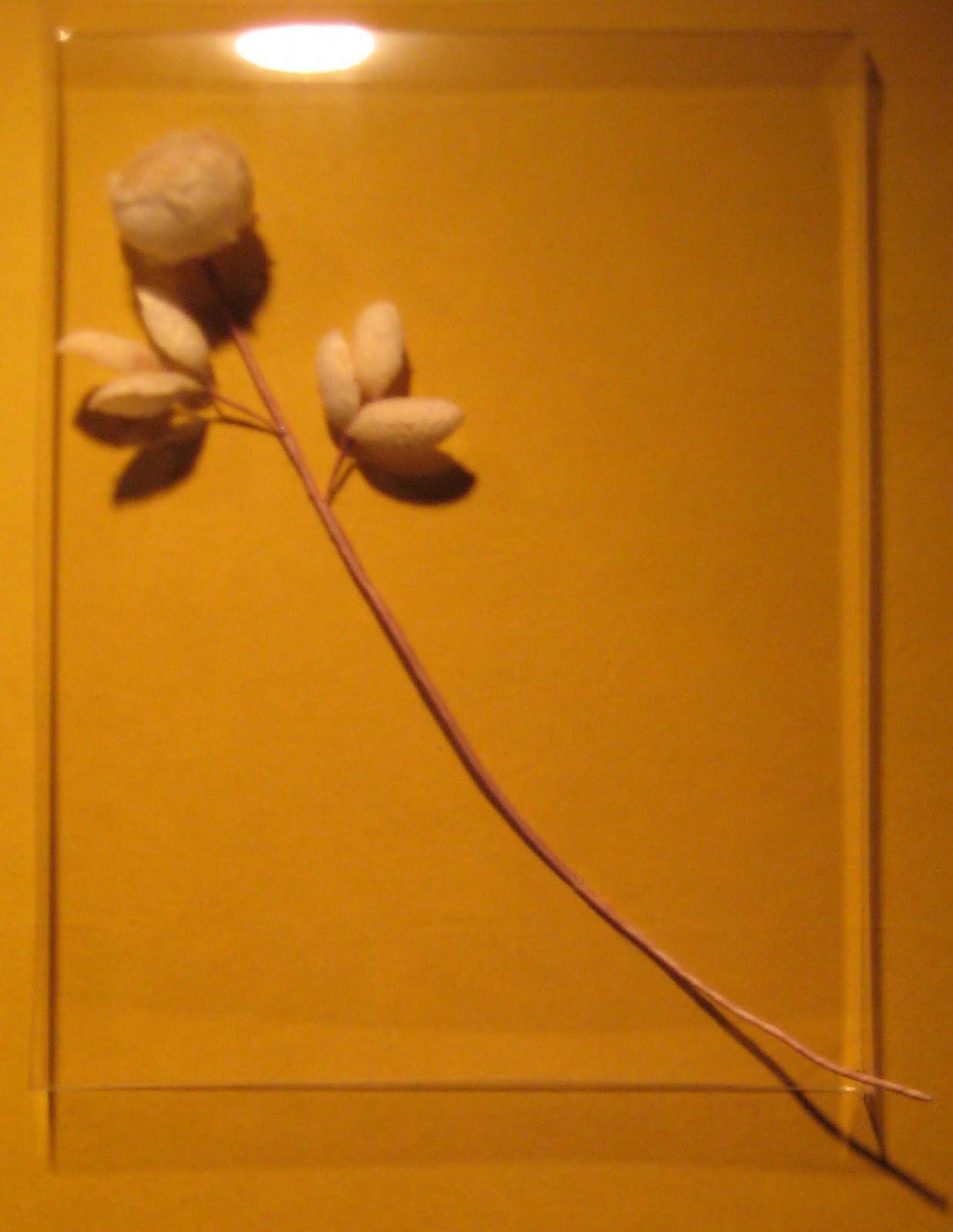
I visited the Japanese Consulate in Washington DC this fall to view HANAMAYU, an exhibit of silk cocoon flowers. The flowers are so unique and beautiful, I think the blog readers would enjoy seeing the photos and hearing about the process.

Hanamayu is an original art form created by artist Tomike Sakai. From the Japanese hana, meaning flower, and mayu, meaning cocoon, hanamayu are timeless flower arrangements composed of silk.
The silk cocoon is a strong and lightweight material. The flower is created through a simple yet delicate process of gently twisting the silk cocoon between the artist’s fingers. The artist takes advantage of the natural shape of each cocoon.

The photos show the process

1. Silkworm caterpillars make silk cocoons during their process of metamorphosis. The cocoon is spun from a single silk filament stretching1300 meters long when unwound. The small silkworm entrusts his life to this thin thread.


2. The silk thread is made in Japan. Over the centuries, Japan has developed beautiful and distinctive silk threads. The kimono, the traditional dress of Japan and a symbol of Japanese culture, is woven from silk.

3. Hanamayu uses waste cocoons which are dirty, damaged or have already been used for silk. Though often stained or misshapen, when dyed they display a beautiful variety of shades.


4. A petal shape is cut with the natural curve of the cocoon. Many thin pieces are peeled off of the cocoon.


5. Layers can be peeled from the petal shape to make multiple petals, which are then glued together to form the flower. Layers are peeled from the cocoon in a similar manner to form the leaves.


6. Finally, petals and leaves are joined. The flower is complete.


The exhibit included arrangements that celebrated seasons. Here are two of the seasons…..


Spring
Small peach blossoms like these, which express the joy of the coming of spring, are displayed along with the Emperor and Empress dolls during the Doll’s Festival, on March 3rd.


Winter
The camellia is displayed with a small rice cake, a good omen for the New Year’s harvest and a common site during the New Year’s celebration of oshougatsu.

Many of the works on display were most recently showcased at the Shanghai World Exposition in June 2010 in both the Japan pavilion and the reception hall.  Here is a link to a site:  http://www.hanamayu.com/ It has better pictures.

Thursday, November 25, 2010

It's a butoh dance! it's a SJG guide!

by aleks

We normally do not put advertisements on this blog, but this deserves an exception:  our own guide, Joan Laage, directs and dances butoh in the upcoming December production.  I wouldn't want you to miss this DaipanButoh presentation :  December 9th @ 8:00 Pm; Good Shepherd Chapel, Seattle,  4649 Sunnnyside Ave. N.
Photo by Briana Jones

Saturday, November 20, 2010

Less is More

by Monzie

SJG • 11/17/10 photo by Monzie
When the garden's front gates closed for the season November 14, activity shifted to maintenance.  I went over to watch the work in progress in rain and less rain.

Parks staff and consultant Masa and his crew were providing observers with a two-week double header this year.  Workers were thinning and eliminating along the garden's east side between the main path and fence in addition to pruning some 50 pines and tending to other annual tasks.

Result:  New, more open vistas to the east! 

Scripts for visitors may need amendment.  Shizue was there, carefully noting eliminations.

When supervisor Lisa came by she talked about the fundraising planned so the west side can receive the same attention next year.

After watching the thinning and eliminating - and enjoying the heavy scent of cedar - I paused by the pruners doing a high wire act in front of the Emperor's Gate.

Farther along, a drowsy mini-school of koi languidly waved their tails

At the north end's five pines, three pruners closely examined branches, then snipped, showing me how they had opened the tree and enhanced the layered, windswept look.

Leaving the garden,  I passed large branches on their way to the truck outside where they were reduced to chips.


I looked back at the closed gates.  When they reopen February 13, the garden will have a new, more expansive look.  Truly, less is more.

Sunday, November 14, 2010

Sayonara. Till spring...

by aleks

SJG - 11/14/10,  4:00 PM • We Closed the Garden.
The staff and volunteers will welcome you back in February 2011.

The last tour of the year is over. The last sitting of Katsura exhibition is done.  The garden season of 2010 is finished.  A couple from Snohomish (she originally from Texas and a he from England) took the tour, as well as a couple from Seattle and a happy, smiling lady I don't know where from, because she joined us half way through the tour.  A very strange feeling to be doing the last tour of the season.  If it wasn't for the fact that I was scheduled for Katsura sitting I'd drag it forever to try defy the time and make it last a little while longer.
SJG • 11/14/10 - It's getting dark.  Lantern reflection in the pond...

We all took in the last sights of the colorful autumn garden: the red maples and yellow ginko leaves, the late afternoon light breaking through the clouds and gently caressing the evergreen pines, even the tiny drizzle of rain which which felt like happy tears upon seeing the image of perfection.  The last fall haiku in Azumaya read:
trusting its fate 
to the autumn wind...
duckweed
Kobayashi Issa, 1808, translated by David Lanou

And what is duckweed?  Somebody asked. I don't really know, will check. A plant, or something, which will travel with wind, trusting to be deposited where it needs to be.

We came across Mary Ann C. horsing around like a kid while picking the ginko leaves for drying:  it's true, they are like this - pretty and yellow - only shortly this time of the year:  'It'll be good to dry them and show them to people touring in the spring'.  Besides, she said, she just wanted to steal the last glances of the Garden before it closes for the rainy season.
SJG • 11/14/10:  Kids:  'Good night, fishes!'

Many people and children were doing the same:  trying to catch the last sight of koi, the last view from the Kobe lantern position's on the top of the mountain hill, the last picture of of the fall leaves.  Everybody happy, kind of  in a dreamy mood of the 1947 'Goodnight moon' bedtime story by Margaret Wilson Brown: goodnight red maple, goodnight Mr. Yamazaki pine, goodnight bridges and lanterns...  Goodnight kingfisher - was it you, making so much noise above the lake tonight?  Were you, too, saying goodnight?  You can fly over the admission booth tomorrow...

Michele was Katsura- sitting when i breathlessly arrived in the T-room for my photo-sitting shift.  No, she and Mary Ann K. wouldn't mind if I went back to take a few last pictures and collect a few ginko leaves myself.  So I walked back, and saw a happy young man smiling at the scenery, just breathing and taking it all in.   He later stopped by the Katsura exhibition, but it was closing now, too.  David is his name, it transpired later, when we chatted in front of the now closed gate, from Boston, presently living in Seattle - hopefully chiming in here soon, so I can tell him about other gardens, open all winter here.

SJG • 11/14/10 • 'Is that the tree everybody
is talking about?'   Yes, ginko 'snow'

When I was taking the last pics of ginkos a young couple joined me: she was training her camera lenses on the  leaves covering the ground, while he asked: 'Is that the tree everybody is talking about?'.  Yes, yes. 'The snow of ginkos on the ground?'  That's it.
--------------------
P.S. Duckweed, or water lentils, the smallest flowering plants,  are aquatic plants which float on or just beneath the surface of still or slow-moving fresh water bodies...