An example of a display area at JCCCW. Photo by Nat S.
It has been 70 years since the signing of Executive Order 9066
which led to the mass roundup, removal, and incarceration without due process
of over 110,000 Japanese Americans. This period in U.S. history is a stunning
reminder of the fragility of our civil rights.
On 16.June.2012, the Northwest Nikkei Museum, which is at
the recently renovated Japanese Cultural and Community Center of Washington (JCCCW),
officially opened a new exhibit, Art
Behind Barbed Wire:A Pacific
Northwest Exploration of Japanese American Arts and Crafts Created in World War
II Incarceration Camps.
Please
see JCCCW for more information about this exhibit and the
cultural center itself as a valuable local resource.Hours are Monday through Friday, from 10am to 4pm, and by
appointment on Saturdays.Guided
tours for individuals or groups will also be available upon request.
The JCCCW, which is comprised of three structures, is an
historical site itself, having served as transitional housing for Japanese-American
families returning home from their incarcerations after WWII.
The Japanese Cultural and Community Center of Washington, 1414 S. Weller St Seattle, (206) 568-7114. Photo by Nat S.
Whether or not you’ve already visited the Bainbridge Island
Historical Museum or the Japanese American Exclusion Memorial on Bainbridge
Island, a visit to the JCCCW and its current exhibit is highly recommended.
Items on display were largely made using objects—scrap wood,
pebbles, even tiny lakebed shells-- found around the bleak camps.The range of items on
display is wide:e.g., inlaid furniture,
paintings, ink drawings, paper ephemera, pebble vases, various sizes and types
of carved wood objects.
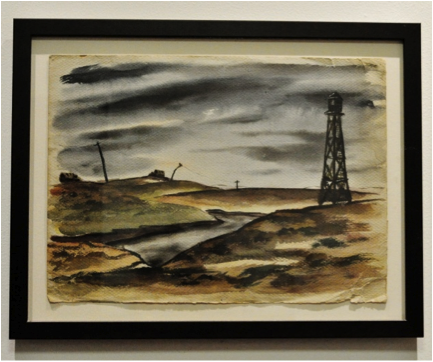
Approach to Minidoka”, watercolor by Masao “Mike” Kawaguchi. Photo by Nat. S
Some works were done by trained artists, such
as Masao Mike Kawaguchi.Mr.
Kawaguchi worked for Disney before and after the war, and for Hanna
Barbera.During WWII he served
in the 442nd Regimental Combat Team in Italy, France and Germany;
and for military intelligence in Guam and Iwo Jima. He painted scenes of everyday life in the incarceration
camps when he was on furlough to visit his family imprisoned at Minidoka, Idaho
and Heart Mountain, Wyoming.What irony.
“Chow Line” by Masao “Mike” Kawaguchi. Photo by Nat S.
All items in the exhibit attest to an astonishing strength, creativity
and perseverance of Japanese Americans forced from their homes, land and
livelihoods to live under adverse conditions in incarceration camps.
Carved bird pin by Hanzo Shimokawa. Photo by Nat S.
On a personal note:my husband’s grandfather, who’d been a resident of Hawaii, was
imprisoned at incarceration camps run by the Department of Justice on the U.S.
mainland.One of the pins
carved by Grandfather in the camp is included in the exhibit.Grandfather’s only son served in the 442nd during
WWII.
This flyer came with email from Rachel, who is the events coordinator at SJG - everyone is invited to attend in support of the Garden:
Come to a summer evening party in the Japanese Garden and enjoy taiko drums, shakuhachi flute, wandering geisha, sushi and salmon, wines and sake. This year’s party includes an opportunity to bid on round-trip business tickets to Tokyo, sculpture by Gerard Tsutakawa, original Mariners package, an evening at Nishino’s, and more.
aleks: Children's day is a national holiday in Japan, celebrated on
May 5th each year. How the Japanese children celebrate the day? In SJG
they get to learn origami, zen gardening, play-dressing up in kimonos and
yukatas, watch Japanese puppetry and taiko drummers - all 'educational'
fun. Is it the same in Japan or different? Do children play games we should
learn about and maybe teach here, too?
Keiko:In modern
day Japan, the parents are expected to take children out to places, such as
Tokyo Disneyland, local zoo or a park to have fun together. In many cases,
fathers are often very busy for their long working hours and long commute. This
day is a good reminder that children need to have fun with their parents.
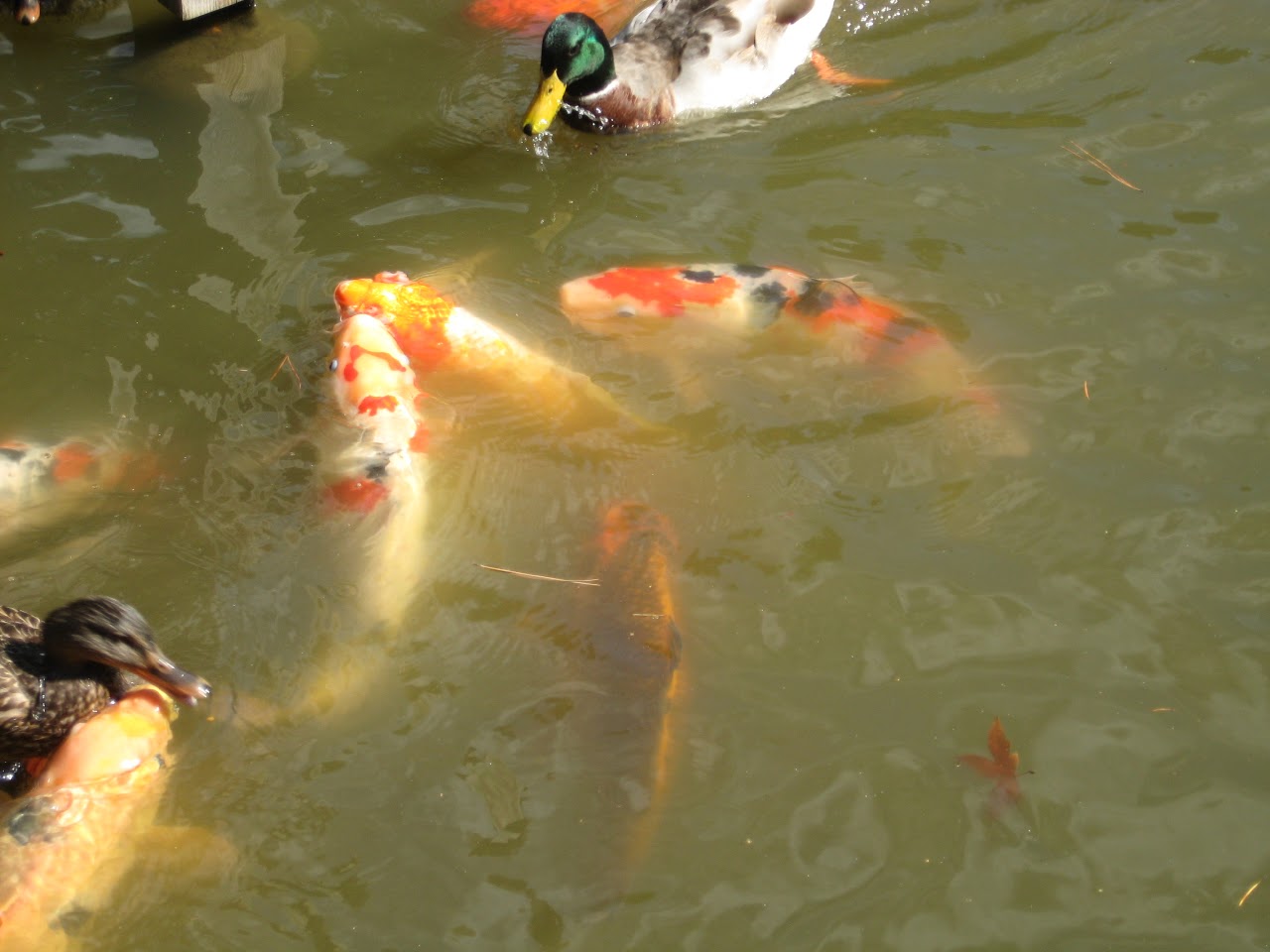
SJG Children's Day • 5/28/12 - fun with Koi feeding
a: How about food? Is there a type of food associated with Children's
Day? Here it would probably be ice cream. Are there some treats that
Japanese children especially love and expect that day?
There seem to be different kinds of chimaki all over Asia.
But chimaki for me is Japanese glutinous rice cooked in wrappings of bamboo
shoots skin (or bamboo leaves.) I have read that its origin is portable food
for soldiers over a thousand years ago. Chimaki could have been eaten for days
(weeks?) after it had been prepared. I think the story is believable because
the chimaki is traditionally cooked in lye (yes, you've read it right), which
is caustic solution made by leaching wood ash (aku= 灰汁) capable of killing bacteria.
In Kagoshima prefecture from where my parents are, chimaki
is called akumaki. (Maki means roll.) I think akumaki is close to its original
form because of Kagoshima's long distance from central area of Japan; Kagoshima
preserved many kinds of old fashioned food and customs. Once a year, our
relatives in Kagoshima sent us a package of akumaki wrapped in bamboo shoots
skin. The glutinous rice had a unique flavor from aku but had no other ingredient.
It was not even sweet on its own. While it could be eaten cold, my mother
sometimes steamed them and we ate the cut sticky pieces with soybean
flour (kinako 黄粉)
mixed
with sugar. It was a treat.
Speaking of chimaki, here is an old Japanese children's
song, "Seikurabe = Comparing Height," in which a child thinking of his
big brother marking his height on the pillar while eating chimaki:
"The mark on the pillar was from two years ago.
My big
brother marked it for me while eating chimaki on May 5th.
Yesterday, I
compare my current height with the mark
and
found out that I grew only by the length of haori strings."
I had no idea what "the length of haori (Japanese
style jacket) strings" meant since haori was not my everyday attire. The
song is from the1920s when Japanese style clothing was still common in everyday
life. (For your information, the length of haori strings is 10 cm or so
= 3.5 inches.) The second verse describes the hills and mountains
comparing their heights and concludes at the end that Mt. Fuji is number
one even without its cap of snow.
Every time we had chimaki, my mother sang this song
thinking of her own big brother who had passed away young. Up until 1990's, all
the Japanese children learned this song at elementary school. I bet all of your
fellow guides from Japan know this song!
Kashiwamochi is a rice cake with sweet red
bean paste wrapped in oak leaf. At this time of the year, you can purchase
this special treat at your local Japanese grocery store (Hint: starting with U)
in Seattle and Bellevue or from your local Japanese sweets makers.
SJG Children's Day • 5/28/12 - Japanese puppets
a: Are they any Japanese words associated with the celebrations you
can think of that we could learn?
K: How about “Kodomo 子ども(children)
noの (of) hi 日(day)”?
a: I read on Kids Web Japan about children's kyogen recital
in Yokohama one year - is children's theater common as Kodomo no hi
entertainment and have you seen any such performances?
K: Wow. I
have never heard of children's kyogen. It must have been very unique
experiment. The ideas of children’s theaters are novel in Japan.
SJG Children's Day • 5/28/12 - Origami station
a: Can you share your memories of Kodomo no hi?
K: The Children's Day has been
always a part of "the Golden Week" when many of us can relax and do
what we want to do instead of going to school or work.
a: So, there is no school on Kodomo no hi? Or does
Kodomo no hi simply falls on the Golden Week? I googled GW and am no wiser -
seems to me that it is a string of holidays commonly used for family
vacation - or that is how I understand this wiki entry. Can you enlighten us?
K: You are
right. GW is a string of holidays for family vacation. It is a big deal for
Japanese families since it is not so easy to take vacation from work for many
Japanese workers. Depending on how you and your company manage your work days,
it can be a vacation of whole week or more.
Also, the Japanese school year begins in April and many
of us are under a lot of stress by the end of the month. Adjusting in the new
environment is a lot of work. I think that GW is a nice break from it.
a: In most places I lived the end of April and beginning
of May would be simply too cold to go for vacation, people wait for warmth of
July and August; is Japan different that way? Is the weather good at that
time?
K: Beginning
of May is a beautiful season. It is before the infamous rainy season starts. I
believe that for most people in Japan, May is associated with flesh greens and
flowers everywhere.
Happy
KODOMO NO HI to all who managed to remain KIDS
in
their hearts from Keiko and aleks : )
SJG Children's Day • 5/28/12 - Kimono Room (in TCR) - - one has to dress properly for strolling the Garden
! Reminder for docents: Continuing Education
Meeting next Thursday, June 14th at 10:00. The speaker will be Carolyn Staley of Carolyn Staley
Prints, and her subject will be "Japanese Seasons and Gardens in Antique
Prints and Books."
Why does the duck cross the road? Why does the duck's mate cross the road? I couldn't figure it out, but I watched them walk the perimeter of the south west area near the Korean pagoda. I wonder if they were looking for a good place to hide a nest. They were not at all secretive about their trip. But, it was fun to watch them waddle near the fence. They were very determined and not concerned about the number of people watching them. I had to get back to the gate house to meet my group, so I don't know why they crossed the road...
Female Mallard, photo by Lynnda
I guided two tours last week on the same day, two very different groups. The first was a group of women from a local garden club. Guiding garden club tours sometimes makes me nervous. Just a few questions from them and they'll immediately know I am a least knowledgeable plant identifier. I am not a botanist nor a biologist, hardly even a gardener. I love walking around the garden, and I love to share that love with garden visitors. Fortunately, this delightful group of women didn't ask plant questions that I couldn't answer. Had they asked for specific identifications, I would have directed them to the link for the plant book, found here.
Rhody, photo by Lynnda
The second group I guided was first grade girls from a Brownie troop. I've not guided very many children's tours, actually, only one. And that one was almost a disaster (2 dads, 7 fourth graders, 7 magnifying glasses and a dad-taught quickie on fire starting 101). Two years later, I'm guiding my second youth group. These girls were GREAT! They had small notebooks and pencils, and were diligent in recording what I was saying. What surprised me was my talking about the same items to each group. We stopped to look at the sapsucker holes in the cypress. On the back trail near the start of the stream, we stopped to feel the softness of the Rhododendron yakushimanum. Both tour groups loved the rich suede leaf.
Acer palmatum 'Shigitatsu Sawa', photo by Lynnda
Both tour groups were enchanted by the view looking up into the leaves of the Shigitatsu Sawa maple, just to the south-west of the tea house. The delicate leaves are often missed because we are being careful to watch where we're walking. At this point on the tour with the girls, I found I was taking time to spell words for them to write in their notebooks. They were doing a lot of writing! I told them their memories were so good, they could listen to what I was telling them, and then we could choose one or two words to write in their note pads to remind them what they saw.
Turtle enjoying the sun, photo by Lynnda
The sun was out and there were so many turtles lounging on rocks near the water. Feeding the koi is always a treat for all ages. The fish never seem to be full. The Brownies especially enjoyed trying to place the fish food close enough for the turtles to grab it before the ducks or fish devoured it.
Koi feeding, photo by Lynnda
We talked about all the senses that come alive in the Garden. Fragrances would suddenly arrive, and the source could not always be identified. We enjoyed the difference in sound between the stream and the waterfall. Many birds were flitting throughout the trees. The sun was brilliant on some of the paths, and on others, we were in the shade and couldn't feel its warmth. There were so many shades of pink, from the palest, almost white, to brilliant deep pink. Each group had interesting observations throughout the Garden.
Although the two groups were very different in so many ways, the joy of the Garden was appreciated by each group in their own way. The experience for me was equally pleasurable with each group. I have new enthusiasm for leading school groups. I'm still gathering my courage to volunteer for a high school Japanese class. Maybe next year...
The Philosophy Department of
Bellevue College hosts "Introduction to Zen Buddhism" in their
Philosophy Talks series. This informative presentation is free and open to
public.
When: Thursday, May 31,
11:20-12:20 Where: BC’s Library Media
Center, room D106 Presenter: Alanna Gram
Gram will offer a brief
survey of Zen Buddhism from its historical origins to its philosophical
principles. She’ll examine the historical influence of Zen, the significance of
Zen koans and sitting meditation, ethical precepts and the notion of
Enlightenment, anti-intellectualism in Zen, and the perplexing nature of Zen
metaphysics. Listeners will learn and be able to identify Zen motifs and core
tenets, as well as gain an understanding of key Zen principles and an
appreciation for the complexity of Zen thought.
Gram is a past president of
the BC Philosophy Club and one of their top philosophy students. Gram is
also the first BC student to offer a presentation in the Philosophy Department’s
quarterly Philosophy Talks series. For more information, please
contact Mark Storey, BC philosophy instructor and series coordinator at mark.storey@bellevuecollege.edu
or 425-564-2118.
• • • • •
p.s. aleks chimes in: which campus it will be, Keiko? do you know? Main or North campus? (links to both included)
SJG • 5/28/12 - Today was the Children's day in SJG, including a fun-workshop on zen-gardens. More on this event coming soon; pic by aleks
The
Unit 86 Japanese Film non-committee (Shizue, Monzie, Nat S. and aleks) would like to share documentary and feature films
depicting different aspects of Japanese history and culture. Each film will be
prefaced with a short introduction. And there will be time for a
post-screening discussion. Volunteers and staff of the SJG, and their
guests, are invited to attend the following movies in Tateuchi Community
Room:
• JUNE: Thursday 6/28/12, 1:30 pm
- Dream Window: Reflections on the Japanese Garden, 1992, from
the Smithsonian video collection; it features the gardens of Saiho-ji,
Shugaku-in, Katsura Villa, Tenryu-ji, and Sogetsu Hall, plus contemporary
landscapes. A diverse group of Japanese artists provides an excellent
commentary. Trailer here, IMBd. 1992, music by Tôru
Takemitsu. 57 minutes
• AUGUST: Thursday 8/23/12, 1:30 pm -Japan, Memoirs of a Secret Empire, Part One: "The Way of the Samurai".In
2004 PBS aired a 3-part documentary series on the history of Japan's opening to
the outside world;viewers' comments on shoppbs and at amazon. 60 minutes
• OCTOBER: Thursday 10/18//12, 1:30 pm - Tokyo Story (Tōkyō Monogatari), 1953, by
widely acclaimed director Yasujirō Ozu. It is regarded as one of the 10
greatest films of all time. The story is of a visit made by an aging
couple from a small town to see their children and grandchildren in distant,
growing, postwar Tokyo. With elegance and sensitivity the film portrays
characters with whom we can identify, and taps human experiences common to us
all. (For more background clickRoger Eber review from 1972 and 2003.) 136 minutes - a brief intermission
is planned.
• NOVEMBER: Thursday 11/1/12, 1:30 - Shall
We Dance? 1996, dir. Masayuki Suo. A successful but unhappy
Japanese accountant finds the missing passion in his life when he begins to
secretly take ballroom dance lessons. Trailer
here, Rotten tomatoes reviews here. 120 minutes.
If you want to see these films, befriend SJG volunteer or a staff person, OR become a volunteer for SJG yourself (SJG needs all kinds of people: gardeners, event organizers and general lovers of Japanese culture + paging Kenn of 'Deputy Docent' who volunteered programming of iPhone app for SJG).