Thursday, August 16, 2012

Thursday, August 23 • 1:30 pm: Japanese film in Tateuchi Community Room

by aleks
Our second film this season will be 'Japan: Memoirs of a Secret Empire' - parts of the 2004 PBS documentary series.  There is a change from the original plan, though: Shizue, the host of the Thursday session, after further reviewing of the film decided that part 2 will be more interesting to watch, more about people and customs  than originally planned rather dry part 1. Since we have Tateuchi Room reserved till 5 pm, part 3 will be shown after a brief intermission for those who are interested.

The whole thing is on youtube, so if you want to watch the part 1 ahead of screening (not necessary), here it is, in several installments, we hope you are going to join us for part 2 and 3 and a good discussion (plus cookies!):


or here:
http://www.youtube.com/watch?v=czcfgeOQNmY

The PBS description of parts looks like this:

Program OneEPISODE ONE: THE WAY OF THE SAMURAI
Tokugawa Ieyasu unifies Japan and establishes a dynasty that will rule Japan for over 250 years. 


Program TwoEPISODE TWO: THE WILL OF THE SHOGUN
The grandson of Ieyasu, Tokugawa Iemitsu, tightens control over Japan's warlords and expels all foreigners. 


Program ThreeEPISODE THREE: THE RETURN OF THE BARBARIANS
Isolated from the West, 18th century Edo flourishes culturally and economically, becoming one of the liveliest cities in the world. But foreign forces are coming. 


• • • 
About the previous film:
If we were unable to attend the first session of the 'films in Tateuchi Community Room', the beautiful 'Dream Window' movie (featuring the gardens of Saiho-ji, Shugaku-in, Katsura Villa, Tenryu-ji, and Sogetsu Hall, plus contemporary landscapes +  a diverse group of Japanese artists providing an excellent commentary), talk to Thomas: he has a copy of it in his drawer, and willing to lend. This Smithsonian video offering is NOT available in the general dvd collection on amazon or anywhere else, and trade with Smithsonian will short you for about $150 :(.

• • • 

About the next films:
After  next Thursday, the last two film offerings for this season will be:

• OCTOBER:  Thursday 10/18//12, 1:30 pm - TokyoStory  (Tōkyō Monogatari), 1953, by widely acclaimed director Yasujirō Ozu.  It is regarded as one of the 10 greatest films of all time.  The story is of a visit made by an aging couple from a small town to see their children and grandchildren in distant, growing, postwar Tokyo. With elegance and sensitivity the film portrays characters with whom we can identify, and taps human experiences common to us all.  (For more background click Roger Eber review from 1972 and 2003.) 136 minutes - a brief intermission is planned.

• NOVEMBER:  Thursday 11/1/12, 1:30 - Shall We Dance? 1996, dir. Masayuki Suo. A successful but unhappy Japanese accountant finds the missing passion in his life when he begins to secretly take ballroom dance lessons.  Trailer hereRotten tomatoes reviews here. 120 minutes.

Again: this is a private event, for guides, staff  and their friends only (for mainly legal reasons), but if you want to see these films, befriend SJG volunteer or a staff person, OR become a volunteer for SJG yourself... You are invited, one way or the other.

HOPE TO SEE YOU THERE next Thursday!

Sunday, August 5, 2012

Wandering & Wondering - Saturday, August 4

by aleks
SJG • 8/4/12 - Wandering & Wondering

Another wonderful performance of butoh dance in the Garden, which became even more magical with the sound of delicate music coming from different directions and dancers appearing and reappearing on the paths, solo here, and as a group there.

SJG • 8/4/12 - Wandering & Wondering

Two six years old girls who came with us to see butoh dancing were very interested in figuring out what is happening;  they pretty soon determined that the entire Garden became a stage, or that the dancers are part of the Garden - pretty much doesn't matter which way around: 'Look, she is gardening, and pretending  she is smelling the flowers,  and now watering them'....

SJG • 8/4/12 - Wandering & Wondering

'They are having a party now, pretending they are talking and laughing' -  the group was sharing a drink of water, and it didn't escape the girls that the dancers didn't stop performing, but incorporated that activity into the dance. 'They are hugging and saying goodbye now' - on the group splitting and wandering off to different corners of the Garden again...

SJG • 8/4/12 - Wandering & Wondering - Sadie and Ellie watching... Pic by Michal
The event was directed by Joan Laage, of Kogut Butoh based in Seattle. Dancers were  Bruce Fogg, Consuelo Gonzalez, Joan Laage, Lin Lucas, Kaoru Okumura, Vanessa Skantze and Helen Thorsen. Musicians were Susie Kozawa, Dean Moore, Mike Shannon, Esther Sugai and Samuel Yoder.

SJG • 8/4/12 - Wandering & Wondering. Pic by Michal

Thank you dancers and musicians!  And thank you, Joan Laage, who is also a guide in SJG - I shall shadow her tour sometimes, she is probably dancing it....

SJG • 8/4/12 - Wandering & Wondering. Pic by Michal
Ellie's haiku on the occasion on watching butoh in 90 agrees weather:

butoh dancing
very slow -
looked very hot

*******

Sadie and I 
thought the butoh
is having a party!

SJG • 8/4/12 - Wandering & Wondering
I have more pics, but the post is becoming too long - next year you have to see it yourself!

Saturday, July 28, 2012

Our granddaughters

by aleks
SJG • 7/23/12 - our granddaughters - the entrance of  the Garden

On Monday Lynnda and I took our granddaughters - 2 y.o. (minus 2 days)  and 7 y.o. (minus 4 weeks)  to Seattle Japanese Garden:  Ellie has been coming here for years, and Sophie is just starting.  There is something really nice in the fact that Lynnda and I have become friends through our work as guides in SJG, and even nicer to be able to pass our love of the Garden to our grandkids.

SJG • 7/23/12 - new young friends walking up the hill together

I don't know what to write in this post, without breaking any confidentiality rules (which is why I chose not up-close pics, too - the face recognition software that both girls will grow up to live with... well, I'm not going to help with that),  but i just wanted to share this.

Maybe only, that I hope the girls will grow up as inspired by the Garden as their grandmothers are. Maybe some day they'll find some laughter here, or peace and consolation, or maybe they'll  dream their dreams here, or find a connection with something that really matters to them.

SJG • 7/23/12 - feeding koi

Ellie is keeping a haiku journal of her summer in seattle and this is what she created that day (I still write most of her compositions down, but not all anymore; she now can write some of it by herself):

•••
Large flat rock
at entrance 
to magic garden

•••
fuzzy, velvet 
leaf 
on yakushima bush

•••
Sophie drops koi-food,
I push it off the deck -
koi are happy

•••

SJG • 7/23/12 - the Garden visit nearly ending....  see you later my childhood friend!

• • • • • • • • • 

A note about  yakushima rhododendron and teaching haiku to children:  I told Ellie that haiku is an easy way to make pictures with words: all you need to do is make up 3 lines about something  you want to remember - the shorter the lines, the better haiku. This year she learned to simplify her haiku by dropping unnecessary verbs and other grammatical 'luggage', and right now is learning the  concept of kigo (hint-words, denoting seasons).

Even though she only heard Lynnda say 'yakushima rhododendron' and wasn't sure if she wanted to even try to repeat it, she asked me to put the correct name in her haiku, because that is what she wanted to remember. She learned that trick last year while we travelled to Poland together: she wanted to remember correct names of places, rivers and castles we visited, so she asked me to spell them for her correctly in her haiku: she thought 'locking'  the names in haiku is a good way to preserve them,  and that when she re-reads her travel journals when she is older it will all make sense that way, because she trapped 'real' words which are on the maps and in dictionaries...


Sunday, July 8, 2012

Tanabata in kimonos

The following comment was left by Amanda of Seattle/Tacoma Kimono Club, and  it deserves its own post;  she made links to her photo-essay and blog-post about Tanabata Festival in SJG yesterday - THANK YOU, Amanda! aleks


SJG - 7/7/12 - Tanabata Festival;
pic stolen from Amanda's
photo-essay (see links)
by Amanada

I just wanted to say that some friends and I attended the tanabata festival yesterday, and we really enjoyed ourselves! Thank you for putting on the event, and thank you for having this blog! I love reading your blog about the garden, because I don't get to visit very often.


I wanted to share some of our photos we took: http://www.facebook.com/media/set/?set=oa.420063034712822&type=1 (facebook link, I hope it works.) I also wrote a little bit about our visit on my blog, though there are a little less photos: http://kimono-life.blogspot.com/


Again, thanks for the event, and for providing such a beautiful oasis in this city!


SJG • 7/7/12 - Tanabata - go to Amanda's links to see more of pics she and her friends made...

• • • • • 

About Tanabata from wikipedia (go there for the rest of history, story, customs and more):  
Tanabata (七夕?, meaning "Evening of the seventh") is a Japanese star festival, originating from the Chinese Qixi Festival.[1] It celebrates the meeting of the deities Orihime and Hikoboshi (represented by the stars Vega and Altair respectively). According to legend, the Milky Way separates these lovers, and they are allowed to meet only once a year on the seventh day of the seventh lunar month of the lunisolar calendar. The date of Tanabata varies by region of the country, but the first festivities begin on July 7 of the Gregorian calendar. The celebration is held at various days between July and August. [...]

Saturday, July 7, 2012

Closures of Lake WA Blvd in July and August

by aleks, per Thomas and Myrna:

SJG • 6/20/12 -  a child in a hat looks at the rhodies...

hello, SJG volunteers, visitors and guests...

per Myrna:

Arboretum and Lake Washington Boulevard users should anticipate several all-day closures of Lake Washington Boulevard this summer from Foster Island Road on the north end to Arboretum Drive on south end of the park. Access to the Seattle Japanese Garden parking lot will be available from the south end of Lake Washington Boulevard during these closures

Lake Washington Boulevard will be closed to traffic:
·        Sunday, July 15 - Monday, July 16, 2012
·        Saturday, August 11 - Sunday August 12, 2012

* * * * *
per Thomas:

Dear Team:

I just received an update from WSDOT that they cannot close the Blvd. on Saturday July 14th.  The new schedule is as follows:

Sunday  July 15 –
Grind and pave from Interlaken to Boyer

Monday, July 16 –
Phase II of SCL pole placement from Interlaken to Foster Island
Install and bag signs for 2 crosswalks and speed cushions

Saturday, August 11 –
Raised crosswalk (note construction will need to start at 7:00 PM Friday – remove pavement and pour flat portion of x-walk)
Speed cushion
Phase I and III of SCL pole placement, this would require flaggers and change in traffic control plan
Possible spot paving by Madison, this would require flaggers and change in traffic control plan

Sunday,  August 12 –
Install street markings including, center striping of new pavement, sharrows, speed cushion markings, and 2 crosswalks
Steve Hoyos will coordinate with Steve Erickson; only concern is cure time needed for the raised crosswalk

September 8th and 9th -
This is a catch up weekend if the work does not all get done the other two weekends.

Please let me know what parks and U.W. crews are planning on working on each of the closure dates and I will add them into the descriptions.


SJG • 6/20/2012 - Japanese irises are out, too..


Tuesday, June 26, 2012

Art Behind Barbed Wire: A Pacific Northwest Exploration of Japanese American Arts and Crafts Created in World War II Incarceration Camps


by Nat S.
An example of a display area at  JCCCW.
Photo by Nat S.
It has been 70 years since the signing of Executive Order 9066 which led to the mass roundup, removal, and incarceration without due process of over 110,000 Japanese Americans.    This period in U.S. history is a stunning reminder of the fragility of our civil rights.


On 16.June.2012, the Northwest Nikkei Museum, which is at the recently renovated Japanese Cultural and Community Center of Washington (JCCCW), officially opened a new exhibit, Art Behind Barbed Wire:  A Pacific Northwest Exploration of Japanese American Arts and Crafts Created in World War II Incarceration Camps.  

Please see JCCCW for more information about this exhibit and the cultural center itself as a valuable local resource.  Hours are Monday through Friday, from 10am to 4pm, and by appointment on Saturdays.  Guided tours for individuals or groups will also be available upon request.

The JCCCW, which is comprised of three structures, is an historical site itself, having served as transitional housing for Japanese-American families returning home from their incarcerations after WWII. 

The Japanese Cultural and Community Center of Washington, 1414 S. Weller St
Seattle, (206) 568-7114. Photo by Nat S.

Whether or not you’ve already visited the Bainbridge Island Historical Museum or the Japanese American Exclusion Memorial on Bainbridge Island, a visit to the JCCCW and its current exhibit is highly recommended.

Items on display were largely made using objects—scrap wood, pebbles, even tiny lakebed shells-- found around the bleak camps.    The range of items on display is wide:  e.g., inlaid furniture, paintings, ink drawings, paper ephemera, pebble vases, various sizes and types of carved wood objects. 

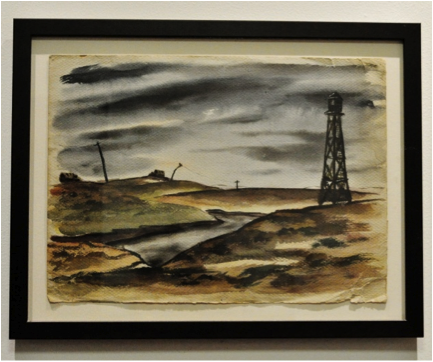
Approach to Minidoka”, watercolor by Masao “Mike” Kawaguchi. Photo by Nat. S

Some works were done by trained artists, such as Masao Mike Kawaguchi.  Mr. Kawaguchi worked for Disney before and after the war, and for Hanna Barbera.   During WWII he served in the 442nd Regimental Combat Team in Italy, France and Germany; and for military intelligence in Guam and Iwo Jima.   He painted scenes of everyday life in the incarceration camps when he was on furlough to visit his family imprisoned at Minidoka, Idaho and Heart Mountain, Wyoming.   What irony.  
           
“Chow Line” by Masao “Mike” Kawaguchi. Photo by Nat S.
                                                                                                                    
All items in the exhibit attest to an astonishing strength, creativity and perseverance of Japanese Americans forced from their homes, land and livelihoods to live under adverse conditions in incarceration camps.   

Carved bird pin by Hanzo Shimokawa. Photo by Nat S.

On a personal note:  my husband’s grandfather, who’d been a resident of Hawaii, was imprisoned at incarceration camps run by the Department of Justice on the U.S. mainland.   One of the pins carved by Grandfather in the camp is included in the exhibit.   Grandfather’s only son served in the 442nd during WWII.