Saturday, December 24, 2011

Christmas in Japan

by aleks
Our November continuing education meeting for the SJG docents was about Japanese Holidays and Festivals (see post from November 9, 2011) - being so close to Christmas date it sparked my curiosity about how is Christmas celebrated in Japan.

Internet is a wondrous invention: with a few keystrokes I came across many interesting descriptions of Christmas celebrations  in Japan; below is one that really grabbed my attention - it comes from TanuTech webpage -  a translation, software localization and publishing company, located in Kawachinagano City, Osaka, Japan.  When you click a link to this webpage, please note that besides this article the website  has an interesting index of Japan related information from Japanese holidays, through Japanese recipes, information on Japanese castles, use and misuse of Japanese language, and more - all written by Billy Hammond, who has lived in Japan for more that two decades.


Christmas in Japan

By: Billy Hammond

Christmas in Japan is quite different from the Chrismas celebrated in most countries in which the population has a large percentage of Christians or a Christian heritage. Only 1/2 of 1% of the Japanese population is estimated to be Christian, with the majority of Japanese being tolerant of all faiths: Buddhism, Christianity, Shinto, etc. In spite of this, the Japanese are great lovers of festivals and celebrations, including Christmas.


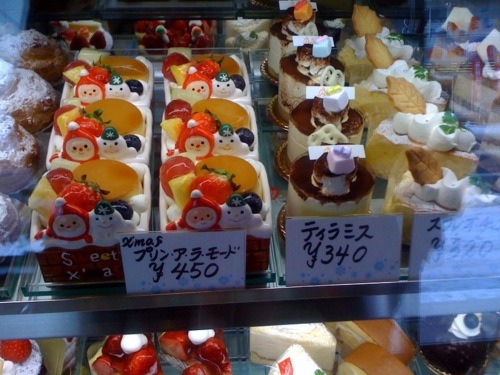
December 25th is not a national holiday in Japan, although December 23rd, which is the birthdate of the present emperor, is. Although it is not an official holiday the Japanese tend to celebrate Christmas, especially in a commercial way. The Japanese celebrate Christmas Eve by eating a 'Christmas Cake' which the father of the family purchases on his way home from work (or his wife does in the case where he has to work on Christmas Eve). Stores all over carry versions of this Christmas cake and drop the price of it drastically on December 25th in order to sell everything out by the 26th. This has resulted in a rather interesting expression in which young girls are referred to as a 'Christmas cakes': marriageable until their 25th birthday and requiring heavy discounts to get married after their 25th birthdays.


In recent years, thanks to the marketing prowess of the folks at Kentucky Fried Chicken, the Christmas Chicken Dinner has become quite popular. Many Japanese even make reservations for their "Christmas Chicken" ahead of time. People line up at their outlets to pick up their orders. As a result of KFC's brilliant advertising campaign, most Japanese now believe that Westerners celebrate Christmas with a chicken dinner instead of the more common ham or turkey.


Christmas Eve has been hyped by the T.V. media as being a time for romantic miracles. It is seen as a time to be spent with one's boyfriend or girlfriend in a romantic setting, so fancy restaurants and hotels are often booked solid at this time. It is often also a time when girls get to reveal their affections to boys and vice versa. Because of this, extending a girl an invitation to be together on Christmas Eve has very deep, romantic implications.
The rest of the article here...
• • • • •

Wonder how do you say 'Merry Christmas' in Japanese? This About.com Japanese Language  has detailed instructions, including pronunciation - if you stay on that page too long, like I did,  you will also find out how to sing the  Rudolf Song in Japanese or get to the Japanese song/animation about Santa Claus (included below) - that webpage is full of holiday fun, so enjoy... :)

Merii Kurisumasu!

Wednesday, December 21, 2011

NYC uses Haiku to bring Poetry to the Streets

by Lynnda
with added 12/22 P.S. from aleks

What a surprise to stumble upon a story about New York City and the use of haiku to provide traffic safety reminders.  This article was aired on December 3, 2011 on NPR's Weekend Edition.  Each haiku is accompanied by boldly colored graphics to illustrate the potential problems of inattention to the warnings. 

Artist John Morse designed 12 signs for display around the five boroughs.  Here are three of the signs.  To see the full story, and see all of the signs, follow this link: haiku in NYC


    John Morse/NYC DOT
 
"One of the joys of doing this sort of thing is how many people have responded to it with their own haiku," Morse says. "There's just a plethora of haiku coming out. It's so exciting."

Haiku is traditionally thought of as Japanese poetry that involves imagery of nature and how that is experienced by the poet.  The standard haiku has three lines and a total of 17 syllables, usually in a 5-7-5 rhythm.

If you feel creative, write your own haiku and leave it as a comment!
_______
P.S. from aleks:  Metro Transit Seattle had a long lasting (1992-2007) public art project 'Poetry on Buses', which started with haiku form, I believe, then moved into more free form.  Here are links to:
 • Seattle Weekly 2007 article about 'Poetry on Buses'  by Rachel Shimp
King County Metro Transit archive of 'Poetry on Buses'  1997-2007 - enjoy!

Sunday, December 11, 2011

LUMINOUS - the Art of Asia at SAM

Website for this image: Poem Scroll with a Deer

by aleks
'LUMINOUS • The Art of Asia'  exhibition at Seattle Art Museum will be displayed till January 8th, 2012  - make sure you see it, as it is quite extraordinary.  It showcases the jewels of SAM’s Asian collections, from Chinese bronzes and Japanese lacquers to Korean ceramics and South Asian sculpture and painting;  but the collection itself is not what drew me in:  how many more vases, scrolls and kimonos one can see in a lifetime -  it is the way it is presented which makes it all very special.

This particular exhibit is all about context - something usually very missing  in museums and  easily making me leave the place when I'm sufficiently dazzled and overwhelmed, but not necessarily wiser.

Artist Do Ho Suh, who put it together, was exceptionally mindful about that very aspect - seeing his way  of arranging material  is a super-satisfying experience and easily incorporated into what one already knows: by learning how objects circled the globe, lost and gained value depending on surroundings, their original meaning (usually sacral) as opposed to current meaning  (esthetic).

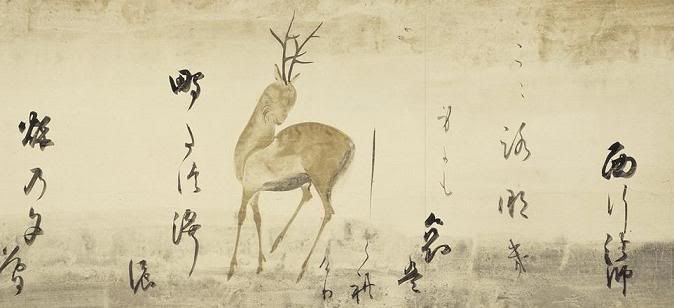
I was particularly touched by a story and exhibit of 'Poem Scroll with a deer' - it turns out that SAM owned the second half of a 72' scroll like forever, but it wasn't until last year's scroll's visit to japan, that it was reunited with the first half, that was in pieces and dispersed among public and private collections there!  here is the scroll and the story:
http://www.seattleartmuseum.org/exhibit/interactives/deerscroll/webSAM_deer.swf

Website for this image: The literature Network Forums

I like to visit exhibitions twice: once with a guide and once by myself (not necessarily in that order)  - this one I'd like to visit many, many times.

Here is more info on the exhibition:

Luminous: The Art of Asia
October 13, 2011–January 8, 2012
SAM Simonyi Special Exhibition Galleries

Hours:
Wednesday–Sunday: 10 am–5 pm
Thursday & Friday: 10 am–9 pm
Monday & Tuesday: closed

Free Days:
All free day programs include access to special exhibitions as well as all SAM collections and installations. Exceptions may apply to special exhibits that carry a surcharge.
First Thursdays: Free to all
First Friday: Free to seniors (age 62+)
Second Fridays, 5–9 pm: Free to teens (ages 13–19) with ID

Friday, December 2, 2011

Nobuko, our fellow SJG guide and friend honored

On edit: 12/3/11 - ooops, only now found and posted text that MAC attached (in blue ink below)
Mary Ann C. (MAC here, on this blog) forwarded this info to me to post:

December 2011 - pic by MAC

I was at the Wing Luke Asian Museum Tuesday night when Nobuko was presented with her Denny Award by the Seattle Parks and Recreation.  It was a festive night with one of our own being very deservedly honored. I've attached the comments made about Nobuko and a couple of pictures for the blog.  This is the last time I ask you to post this for me!  I'll either have to learn or not post again in the future:


Congratulations to Nobuko, who was the recipient of the Seattle Parks and Recreation's Denny Award for “Best New Resource”.  The Denny Award began in 2003 to recognize “outstanding volunteer sterwardship.”  This award was presented to Nobuko at the Awards Ceremony, held at the Wing Luke Asian Museum on Tuesday night (29th).  Laurie (JGAC member) introduced her, outlining the ways that Nobuko has contributed to the Japanese Garden:  “Nobuko has been a member of the Japanese Garden Advisory Council for 3 years, and has worked very hard to reach out to the Japanese and Japanese-American community in Seattle on behalf of the Japanese Garden.  She has taken on the leadership of the committee focused on a new fundraising event – the Garden Party.  


The first party was held in 2010, as a way to recognize the sponsors of the Garden's 50th Anniversary.  Nobuko solicited the majority of the $10,000 raised from these sponsors.  This year, she again led the planning committee for the Garden Party, which succeeded in raising $14,000. Using her connections to the travel industry, Nobuko secured two first class domestic airline tickets for the raffle drawing held at the party.  The local United Ailines representative was so impressed with Nobuko's work that he has verbally committed to providing two business class tickets to Japan as a fundraising prize for next year's Garden Party.  She is also a member of Unit 86, giving guided tours of the Garden, and is involved with the Japan-American Society.  In all of her activities, Nobuko works with people from a variety of organizations and has gained the respect of these groups.  The Garden has benefited from this, by being able to expand its reach throughout the greater Seattle community.”  In her acceptance speech, Nobuko very graciously acknowledged the team effort that has contributed to the successes achieved these past two years.   


December 2011- pic by MAC

Oh, do  learn blogging, Mary Ann - you have so much to contribute, please use me to find out more!
AND SUPER Congratulations. Nobuko!  from all of us at the Seattle Japanese Garden!

- about Denny's award here
- more about about Nobuko's award  here

We love you, Nobuko!

Saturday, November 26, 2011

Lecture on Chinese Garden Design - Wed. November 30


June 2011 - members of Unit 86 visiting Seattle Chinese Garden


Chinese Garden Design & Lore

Inaugural Lecture in New Pacific Connections Series


The Arboretum Foundation and UW Botanic Gardens invite you to join us for a free lecture about Chinese gardens on Wednesday, November 30, from 6 to 8 p.m. at the Graham Visitors Center. The talk is entitled "Chinese Garden Design & Lore" and will be presented by garden writer andWashington Park Arboretum Bulletin editor Jan Whitner.

The lecture is the first in the Pacific Connections Series, an enrichment activity program that we are offering to our new Pacific Connections Garden Stewards.

To mark the kick-off of the series, we are opening up the first lecture to all our members, volunteers, and friends. Space is limited (only 25 seats are available), so RSVP soon to reserve your spot.

Please RSVP to Rhonda Bush by email or phone (206-941-2550).
_______________________________

P.S. from aleks - related links for your pre-lecture enjoyment:

• Chinese and Japanese Gardens  – By Paul Hicks – snip: [...] The great influence of China on the evolution of Japanese gardening is particularly interesting given the many physical, cultural and historical differences between the two lands. A good way to learn about the art of the classical Chinese garden is to visit the New York Chinese Scholar’s Garden at the Snug Harbor Cultural Center and Botanical Garden on Staten Island. [...]

• Thoughts and notes from a lecture by Mark Bourne at the Asian Art Museum, San Francisco - snip: [...] The cultural differences are substantial between Japanese and Western gardens, and even between Chinese and Japanese gardens. The idea of Chinese gardens is something that you walk through, like a strolling garden. For this reason, Chinese and Western gardens have more in common with each other than with Japanese gardens. [...]

Lynnda's post about Seattle Chinese Garden on this blog - snip: [...] Chinese architecture has aspects that are meant to thwart evil spirits. The sweeping tips of the roof are to keep airborn evil spirits from coming to earth. Once the spirits flow onto the roof, they are directed up again by the upward curve of the roof. [...]

Wednesday, November 9, 2011

Japanese Holidays & Festivals

by aleks

Last Saturday a team of our own docents treated us all to a delightful and delicious presentation about the nature of Japanese Holidays and Festivals from Tsukimi (Moon Viewing Festival), through Bunka-no-hi (Culture Day), Gantan (New Year's day), Kodomono-hi (Children's Day), Tanabata ('Evening of the 7th' or Star Festival) to Obon (Holiday commemorating one's ancestors).  Perhaps one day Keiko will write a detailed post about those holidays, below just a few impressions from a grateful attendee of the presentation.

Tateuchi Community Room • 11/5/11  - Continuing Education meeting:
Keiko running PPP on Japanese Holidays and Festivals

Keiko run an overview of all holidays via  power point presentation, while Shizue stepped in here and there,  to demonstrate hands-on examples of games played, dolls and cards used by children and adults during different festivities. Sue did a sub-presentation on '3 friends of winter' (pine, bamboo and plum) and their role in holiday spirit and decorations, including an example of a gate maker kodamatsu and pictures of dishes used where (one so inclined) could find the three friends among other depicted images - all fun and games.

Obon: Chiba, Japan. 2011

We were also treated to a reading of Hiroko's personal memories of celebrating New Year as a child in Japan - her taking the time to record it made us all feeling much closer to a 'real thing' than any official documentary on the topic would do (link to Hiroko's memories below).

TCR • 11/5/11- Learning about hagoita, for a game of hanetsuki.

It was a very lively continuing education meeting, filled with many questions, laughter and sharing - of the many hands-on articles I personally had fun with the English version of 'One hundred poems from the Japanese', translated by Kenneth Roxtroth.  This venerable looking volume, filled with poems as old as 7th century, surprised me with the intensity and sensibility of those short verses;  I instantly wanted to engross myself in the collection of quite often powerful poems, but with wondrous happenings around me in real life I had to postpone it for a future trip to library.

Here a a few offerings from the volume + more on Rexroth archive webpage:

I have always known 
That at last I would 
Take this road, but yesterday 
I did not know that it would be today.
- NARIHIRA (9th century)

That spring night I spent 
Pillowed on your arm 
Never really happened 
Except in a dream. 
Unfortunately I am 
Talked about anyway.
- LADY SUWO (11th-12th century)

TCR • 11/5/11 - Delicious Japanese food Shizue-san kindly shared with us

The meeting ended with food offering: Shizue brought a dazzling variety of Japanese food - a rice dish called chirashi-zushi, daikon and carrot salad Namasu, tofu, beans and different veggies, all neatly packed in traditional  stackable lacquered boxes, while Keiko prepared and presented in a crock-pot amazing amazake  - warm and sweet fermented rice wine with close to zero alcohol content - I found a recipe here, but it looks very involved, perhaps Keiko can share her own recipe. After many years of having cold amazake (PCC co-op sells it  in refrigerator section), I learned  that it's supposed to be served warm, and it was way more delicious that way.   And certainly cold amazake is not as bad as cold pierogis: once in the past I designed a Polish-style dinner, which was prepared without my supervision in someone else's house  +  my instruction were probably not clear, because later I was told that the appetizer was particularly gross: the poor pierogi dumplings were served cold before dinner, instead of being a main hot entry.

THANK YOU! our Continuing Education Committee  and the last Saturday Presenters for this truly memorable teachings - we are lucky to have such an interesting group of people working as a TEAM to educate the rest of us.

•  Link to the lecture's  handout containing a list of all holidays
•  Link to Hiroko's memories of her childhood New Years celebrations in Japan

Below some additional outstanding links courtesy of Keiko-san, who helped me tremendously in researching this little report by patiently providing her time and expertise, sharing many explanations, web-resources, Obon photograph,  as well as a lively discussion on the art of translating Japanese poetry... Thank you, Keiko-san for all the assistance and enjoyment you gifted me with and that went into making this post!

• MacCauley's translation of Hyakunin-isshu from University of Virginia Library
• Sketches of Japanese Manners and Customs (1867) by J. M. W. Silver. (The Project Gutenberg eBook)
• Japanese Irises by the Japan Iris Society
• Free desktop wallpaper (shichi-go-san)