Tuesday, December 16, 2014

SJG Field Trip to Kyoto Fall 2014 What we saw and why we saw it... Part 1 of 3

by Dewey Webster

1.) HEIAN ERA (784 -1185):

 HEIAN ERA (784 -1185):  SHINSEN-EN

• HEIAN ERA (784 -1185) SHINSEN-EN
A remnant of the first Imperial Garden created when Kyoto was founded by Emperor Kammu. The group stands under the Torii gate to the Shinto Shine dedicated to Kammu. I like to start visits to Kyoto here, to pay respects to Kammu, to establish the link between Imperial China and Imperial Japan, and try to grasp it has been here for over 1200 years


HEIAN ERA (784 -1185):  SHINSEN-EN

The orange, arched bridge from shore to Island, emphatically says “China”! Barely reflected is a Dragon Boat, on which, during festivals, people re-enact the Heian/Chinese tradition of writing poetry, while musicians play on boats. However, the Shinto Shrine’s subdued rendering reflects the Japanese preference for natural materials and colors.


HEIAN ERA (785 -1185):  DAIKAKU-JI ŌSAWA POND

• HEIAN ERA (785 -1185) DAIKAKU-JI ŌSAWA POND
Viewing this much larger remnant of a pond garden, now taken over by lotus, we can imagine Dragon Boats with musicians, dancers and poetry writers enjoying themselves out at their large villas set among expansive garden/parks.  Across the waters we can see the buildings nestled in trees, with their orange paint long given up for the weathered wood look.

Kyoto • 11/19/14: Two group members were delayed but here they join us;
alas two others were off somewhere and missed this shot.


2.) KAMAKURA ERA (1185-1392):

KAMAKURA ERA (1185-1392): TENRYŪ-JI

• KAMAKURA ERA (1185-1392) TENRYŪ-JI
The ponds, and large sites, have been scaled back, but references to Chinese, influences remain: the rock composition on the far shore (hard to get to) refers to the Daoist Paradise, The Mystic Isles of the Blessed, with Mt. Horai disappearing into the trees. No longer able to afford large acreage of land, sites which looked on beyond to hills, providing “borrowed scenery” were favored.

TENRYŪ-JI means “Heaven-Dragon-Temple”, this one, painted on sliding doors opposite the garden, does not seem too pleased to have his temple garden turned into a DisneyLand for tourists….


KAMAKURA ERA (1185-1392): SAIHŌ-JI (A.K.A The “Moss Garden”)

• KAMAKURA ERA (1185-1392) SAIHŌ-JI (A.K.A The “Moss Garden”)
First an Imperial villa, then an Amida Paradise temple, now in a Zen complex, in many ways this is a garden gone to seed … er…moss (compare to Tenryū-ji). Trees, as much as moss, has taken over and the shoreline is very natural looking. But note the rocks in the pond are in a pretty straight line. Could they be left over from when pleasure boats were tied up to them?

KAMAKURA ERA
(1185-1392): SAIHŌ-JI (A.K.A  The “Moss Garden”)


• KAMAKURA ERA (1185-1392) SAIHŌ-JI (A.K.A  The “Moss Garden”)
So as reverted-to-natural-state as it may appear, you can bet it gets lots of tender care and attention to keep it “natural” and the moss alive.


3.) MUROMACHI ERA (1393 - 1568): 

MUROMACHI ERA (1393 - 1568):  TAIZŌ-IN 

• MUROMACHI ERA (1393 - 1568) TAIZŌ-IN
The incredible shrinking garden continues…and water has been replaced by washed gravel. But the Paradise Island tradition is there with the creation of a Turtle Island. Alas tourists are not allowed into the building, so cannot see the better frontal view, but from the side we see the flat head of the turtle, the stones of its shell and a glimpse of its flat tail (more like a beaver’s to me…). Rising up the hill beyond is Mt. Horai with a waterfall-stream coursing down into the pond.

A priest gives a tour group an introduction to his temple,
and a tour leader gets a needed break to rest her weary legs. 


MUROMACHI ERA (1393 - 1568):  KŌRIN-IN

• MUROMACHI ERA (1393 - 1568) KŌRIN-IN
Where room allows the raked gravel “water” element can take on the scale of a pond. And rocks for islands, rocks for mountains and rocks for waterfalls is looking familiar.


MUROMACHI ERA (1393 - 1568):  KŌRIN-IN
Besides the main show, temples have other gardens, which often feature other items of interest. Here a Shinto Shrine and a stone lantern fill a back corner. Shrines in Buddhist temples are emblematic of the co-existence of Shinto and Buddhism. Shinto Deities of the earth are by definition everywhere. So it is important for temples to pay reverence to those beneath their feet. And stone lanterns are popular everywhere….Zen gardens, Shinto Shrines, tea gardens, etc..

4.) MOMOYAMA ERA (1568-1603):

• MOMOYAMA ERA (1568-1603) SANBŌ-IN
We visited this but photos were not allowed. One needs to go on line to learn about it. But think rocks. Lots of rocks. An exuberance of rocks.
lhttps://www.daigoji.or.jp/garan/sanboin_detail_e.html

• Some visited another, Chishaku-in, and I hope they post photos and notes about it.
http://damien.douxchamps.net/photo/japan/kansai/kyoto/higashiyama/chishaku-in/

Next posts: EDO and MODERN ERAS...

Tuesday, November 25, 2014

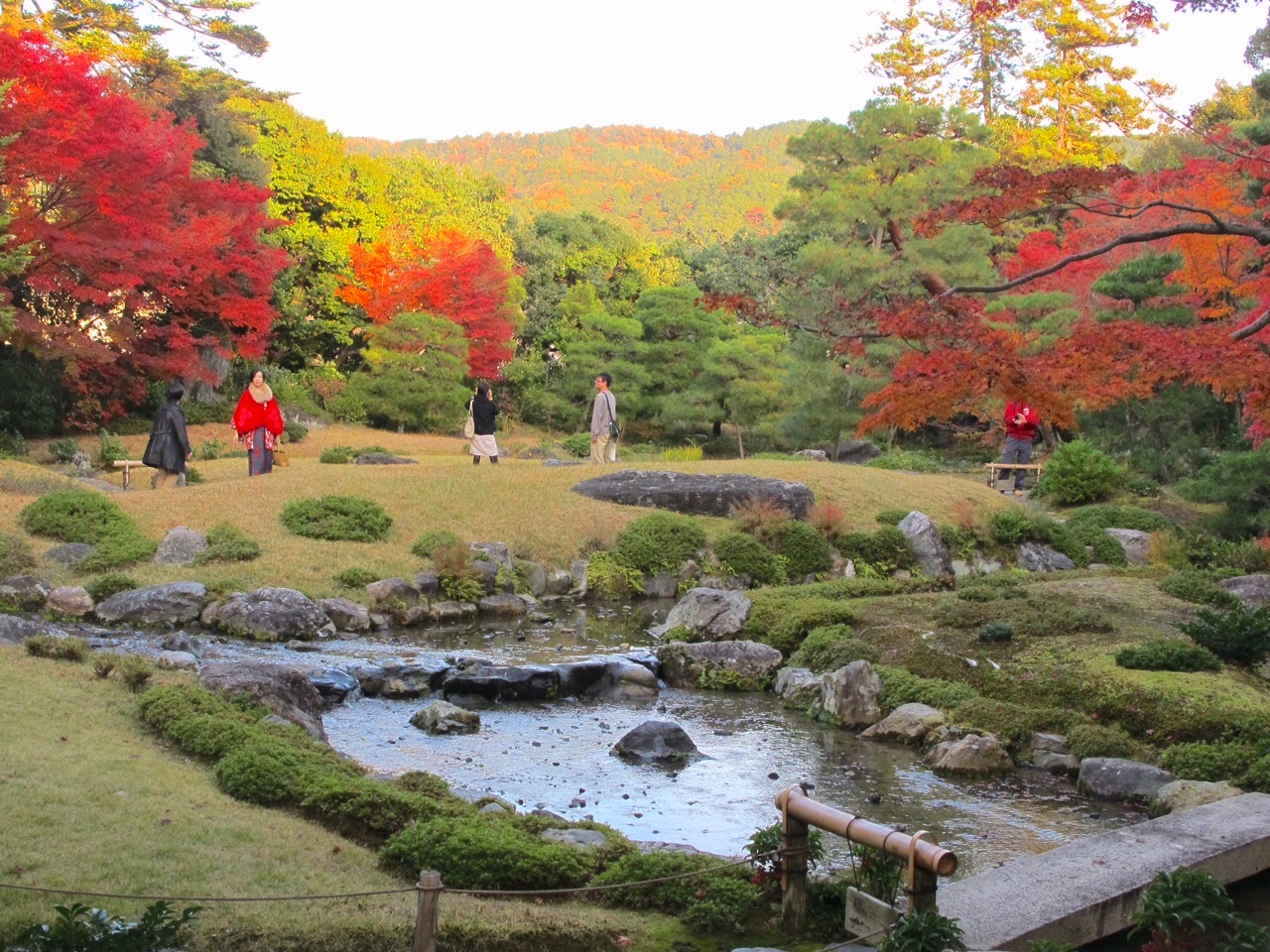
Kurama-dera Temple & Murin-an

11/25/14: Planning coffee near train station at Kurama

From Peggy:
11/23: Today, the entire group, minus Cara & Kim who are now on to Tokyo, took a train ride up into the mountains to Kurama.  Later, Steve & I went to Murin-an and then to Shoren-in Temple that was lit for night. Again, long lines to get in at Shoren-in, but the people keep moving and if you are patient, you get to see everything. 

11/24: 
Everyone went different ways today. Dewey & some went to Lake Biwa. Steve & I went to Ryoan-ji, Kinkaku-Ji (Golden Pavilion) & Kyoto Botanic Garden. 

We all met for a final dinner together, but forgot to take any pictures. We we having too much fun together. 
Peggy

Nov. 2014 - Kurama: on the mountain trail

Kurama-dera (鞍馬寺?) is a temple in the far north of Kyoto, Japan which houses some National Treasures of Japan. It was a member of the Tendai sect and subordinate to Shōren-in from the 12th century until 1949 when it founded its own religious body. The object of worship is esoteric and unique to the temple. It is said to have been founded by a disciple of Jianzhen.

Situated in secluded wilderness at the base of Mount Kurama, it is accessible by its own cable car line, the Kurama-dera Cable. [...] It is an extremely popular temple for Japanese people to visit, owing to the many mysteries and occult events surrounding it, but does not appear in most English language guidebooks. [...] More here....


Nov. 2014 - Murin-an, historic residence: garden

Murin-an (無鄰菴?) is a Japanese garden in Kyoto, built by political and military leader Yamagata Aritomo between 1894 and 1898. It is an example of a classical Japanese promenade garden of the Meiji Period. [...]

Yamigata Aritomo was an important figure in the politics and military affairs of the Meiji Period. Born into an old Samurai family and devoted to military affairs, he traveled to Europe in 1869 as part of a delegation of experts to study the Prussian Army, and when he returned he helped re-organize the Japanese Army on the Prussian model. He became Minister of War in 1873, and was twice Prime Minister of Japan, from 1889 to 1891 and from 1898 to 1900.  [...] More here...


Nov. 2014 - Murin-an, historic residence: entrance


Our field-trippers are starting to come home this week, on different flights, different days and ways.  Have all safe trip home! 


Here is a fitting Kobayashi Issa haiku from 1816 for your trip:

.ぼつぼつと猫迄帰る夜寒哉
botsu-botsu to neko made kaeru yozamu kana

one by one
even the cats come home...
cold nights

Saturday, November 22, 2014

Japan field trip: all the gardens, all the time - from Peggy

Peggy had trouble emailing photos from her iPad, but once she figured it out, we get to see the collection of the gardens our guides visited.  I'm posting just one photo from each garden, not to break the blogger, but I hope that when Peggy gets back she puts all her photos on a flickr account, and I will link to it from here. THANKS PEGGY!!! aleks

The Sentō Imperial Palace (仙洞御所 Sentō-gosho?) 22 acres  is a large garden in Kyoto, Japan, formerly the grounds of a palace for retired emperors (Emperor Daijō). [...] Sento Imperial Palace was completed in 1630 for Emperor Go-Mizunoo's retirement, along with the corresponding Ōmiya Palace for the Empress Dowager Nyoin. Both palaces were repeatedly destroyed by fire and reconstructed until a blaze in 1854, after which the Sento palace was never rebuilt. More here....

Our guides in Sento Gosho Imperial Garden - 11/19/14


The Shugaku-in Imperial Villa (修学院離宮 Shugaku-in Rikyū?), or Shugaku-in Detached Palace, is a set of gardens and outbuildings (mostly tea-houses) in the hills of the eastern suburbs of Kyoto, Japan (separate from the Kyoto Imperial Palace). It is one of Japan's most important large-scale cultural treasures; its gardens are one of the great masterpieces of Japanese gardening. More here...

Shugaku-in Imperial Garden. Upper garden of 3 with pond a fabulous Shakkei - 11/19/14

The Katsura Imperial Villa (桂離宮 Katsura Rikyū?), or Katsura Detached Palace, is a villa with associated gardens and outbuildings in the western suburbs of Kyoto, Japan (in Nishikyō-ku, separate from the Kyoto Imperial Palace). It is one of Japan's most important large-scale cultural treasures.

Its gardens are a masterpiece of Japanese gardening, and the buildings are even more important, one of the greatest achievements of Japanese architecture. The palace includes a shoin ("drawing room"), tea houses, and a strolling garden. It provides an invaluable window into the villas of princes of the Edo period. More here...

Katsura Imperial Garden - Recognize the rocky peninsula? 11/22/14

Tenryū-ji (天龍寺?)—more formally known as Tenryū Shiseizen-ji (天龍資聖禅寺?)—is the head temple of the Tenryū branch of Rinzai Zen Buddhism, located in Susukinobaba-chō, Ukyō Ward, Kyoto, Japan. The temple was founded by Ashikaga Takauji in 1339, primarily to venerate Gautama Buddha, and its first chief priest was Musō Soseki. Construction was completed in 1345. As a temple related to both the Ashikaga family and Emperor Go-Daigo, the temple is held in high esteem, and is ranked number one among Kyoto's so-called Five Mountains.  More here...

Tenryu-ji: with hundreds of others to see the fall colors - 11/22/14

Ginkaku-ji (銀閣寺?, lit. "Temple of the Silver Pavilion"), officially named Jishō-ji (慈照寺?, lit. "Temple of Shining Mercy"), is a Zen temple in the Sakyo ward of Kyoto, Japan. It is one of the constructions that represent the Higashiyama Culture of Muromachi period.   Ashikaga Yoshimasa initiated plans for creating a retirement villa and gardens as early as 1460;[1] and after his death, Yoshimasa would arrange for this property to become a Zen temple. More here...

Ginkaku-ji - 11/22/14

Byōdō-in (平等院?) is a Buddhist temple in the city of Uji in Kyoto Prefecture, Japan.[1] It is jointly a temple of the Jōdo-shū (Pure Land) and Tendai-shū sects.  This temple was originally built in 998 in the Heian period as a rural villa of high ranking courtier Minamoto no Shigenobu, Minister of the Left. The property was purchased from Minamoto no Shigenobu's wife after he died by Fujiwara no Michinaga, one of the most powerful members of the Fujiwara clan. The villa was made into a Buddhist temple by Fujiwara no Yorimichi in 1052.  More here...

Byodo-in; Steve & Peggy joined several hundred at Byodo-in today (11/22) to see the Phoenix Temple with only a handful of non-Japanese in the mix.  It was 70 degrees and a gorgeous day!


Friday, November 21, 2014

Field-trip to Japan continues...

• From Dewey -  meeting locals:
Japan, Nov. 21,  2014: meeting locals (from Dewey)
Japan, Nov. 21, 2014: meeting locals (from Dewey)


• From Steve - Just another day in Kyoto:
Japan, Nov. 21, 2014: Just another day in Kyoto (from Steve)


• From Ruth:  'Well, on the 3rd day we lost our smartphone and so have had no way to send emails or to phone except by using our group leaders phone.  There are not internet cafes anymore because everyone has their own phone!  So we found an international community house with computers and a library and a wonderful space to hang out when it starts raining.

We have been so lucky with weather.  Partly sunny every day and no rain.  All the maples are at their peak and it is cold enouh at night that the leaves are staying on.  The town is ugly gray boxes but the gardens and hills all around are spectacular.  More wonderful than I imagined from the books and photos--but you know me, I have to feel things.'

• From Peggy - Saiho-ji Moss Garden:

Japan, Nov. 21, 2014: Saiho-ji Moss Garden (from Peggy)
Japan, Nov. 21, 2014: Saiho-ji Moss Garden (from Peggy)
Thank you, Gang! We appreciate all your reports, here,  back home in seattle (it rains here now)...  aleks

Thursday, November 20, 2014

Kodai-ji - Lit at Night from Peggy in Japan

Well, our field-trippers are not just eating in  Japan, although that must be fun, too. Feast your eyes on the picks Peggy G. took of Kodai-ji.  (Kodai-ji is a zen temple established at the beginning of 17th century in Kyoto - more info here).  Thank you, Peggy, for great photos!

Kodai-ji - Lit at Night, 11/15/14

Kodai-ji - Lit at Night, 11/15/14

Kodai-ji - Lit at Night, 11/15/14

Kodai-ji - Lit at Night, 11/15/14

Kodai-ji - Lit at Night, 11/20/14

And Dewey reports: Katsura has taken all pines, plants off middle island of amanohashidate...."got too big and crowded".  Mother Nature Spurs growth, Japanese gardens tamp it down....

Dewy included the picture below with his Katsura report   - thank you Dewey!

man on the ladder, fear little pine... (caption by aleks)


Wednesday, November 19, 2014

Leaving Kyoto & waiting for bus to Katsura

Our Field Trippers to Japan, that is.  I do not think they sleep at all. Below pics from the last 24 hrs from Dewey - enjoy!

This batch came with a headline: 'Cara and Kim leave us tomorrow so we are having our first and last dinner together; do you know everyone's names?' (I do, but won't help internet snoopers, so posting without names):

Our guides in Japan, November 2014

Our guides in Japan, November 2014

Our guides in Japan, November 2014

Next batch was titled: 'now we have had too much beer', but only more food in the pictures:


Our guides in Japan, November 2014 - food tour?:)

Separate batch came from Kyoto, captions by Dewey:


Roof top garden.... [Kyoto, 2014]

Christmas has come to the stores  [Kyoto, 2014]

Hmmmmm....  [Kyoto, 2014]

Lunch....  [Kyoto, 2014]

latest from the station while waiting for bus to Katsura;
traditional Japanese restaurant - [Kyoto, 2014]
Thank you, Dewy, and how come we didn't include your group's report from the trip to Japan for 2015 continuing ed. calendar?  Will have to make a special session, I guess.